Alphabet & Pronunciation
By the end of this lesson you will be able to read ANYTHING in Spanish.
The Spanish alphabet is very similar to the English alphabet, but it has one extra letter, Ñ, which has a unique sound. Some combinations like CH and LL are also important for pronunciation. Look out for them below!
One of the easiest things to know about Spanish is that words are generally pronounced exactly as they are spelled, so once you learn the alphabet and sounds, you can read almost anything correctly. Don't worry if you don't know the meaning of words yet, just focus on the sounds and pronunciation for now.
REMEMBER to take this lesson at your own pace, there’s no rush! Read each word slowly, sound out the letters, and remember: making mistakes is part of the journey. You’re already making progress just by being here!
The Full Spanish Alphabet & Pronunciation
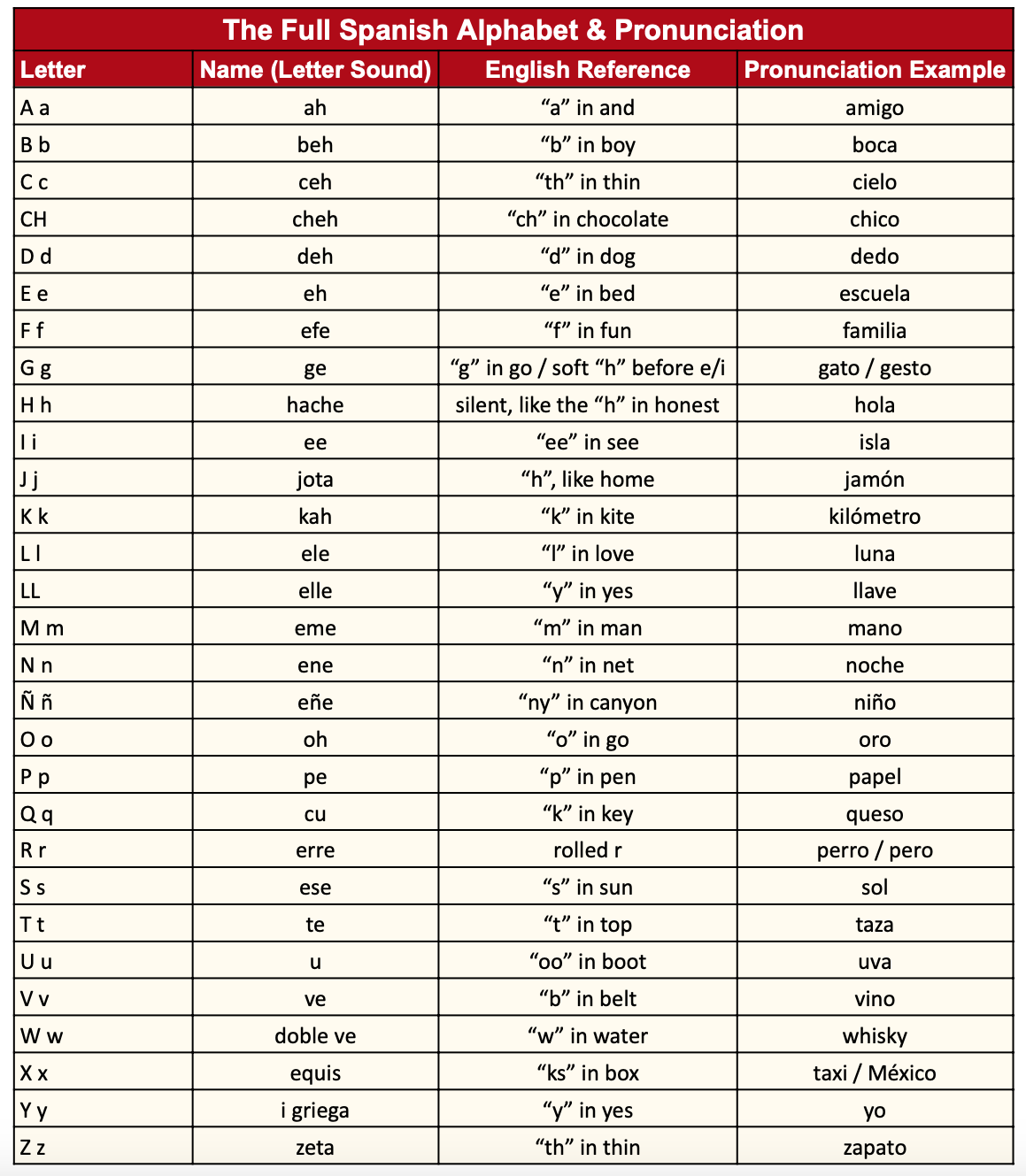
Use the audio below to hear the correct pronunciation. Listen carefully, then repeat the sounds out loud to practise:
Key Pronunciation Tips
Vowels are sharp: A = ah, E = eh, I = ee, O = oh, U = oo.
Words are generally pronounced as they are spelled – no silent vowels like in English (except H, which is silent).
-
In Spanish, the R is not always rolled. A strong rolled R is only used when the word begins with R, such as rojo (red), or when there are two R’s together, such as perro (dog). Do not worry if you cannot roll the R sound yet. This can be difficult for English speakers because there is no real equivalent sound in English pronunciation. Keep practicing!
Next Step: Practice Words & Sentences
Words:
amigo → friend
casa → house
niño → boy/child
hola → hello
queso → cheese
jamón → ham
papel → paper
Once you have practised the words above, use the audio below to hear how they should sound. Listen, then repeat them out loud to check your pronunciation.
Sentences to practise reading aloud:
After practising these sentences, listen to the audio below to hear the correct pronunciation. Try repeating each one out loud a few times to build confidence.
Hola, me llamo Ana. → Hello, my name is Ana.
El niño come queso. → The boy eats cheese.
La casa es grande. → The house is big.
-
¿Cómo estás? → How are you?
CHALLENGE, try reading this short paragraph out loud.
(Don’t worry about being perfect, just take it slow and focus on sounding out each word. You’re making great progress already.) Listen to the audio after having a go yourself, then compare how you did to the audio.
Hola, me llamo Ana y soy de Inglaterra. Estoy en España de vacaciones. Cada mañana, voy a una cafetería y pido un café con leche y una tostada. Después, paseo por la ciudad y visito museos. Me gusta hablar con las personas y aprender palabras nuevas. Por la tarde, compro fruta en el mercado y descanso en el parque. España es muy bonita. ¡Gracias!
Wrap-Up
Congratulations! Now that you know the Spanish alphabet and pronunciation rules, you can read anything in Spanish, you might not know what it means yet, but don’t worry, we’ll get to that soon!
You’ve now learned the full Spanish alphabet and the main pronunciation rules. Remember, words are said how they are spelled, and practising reading short words and sentences aloud will help you gain confidence quickly. Try reading your practice sentences out loud each day this week.
COMING UP: Common Greetings & Goodbyes 👋
DOWNLOAD PRINTABLE SHEETS BELOW